
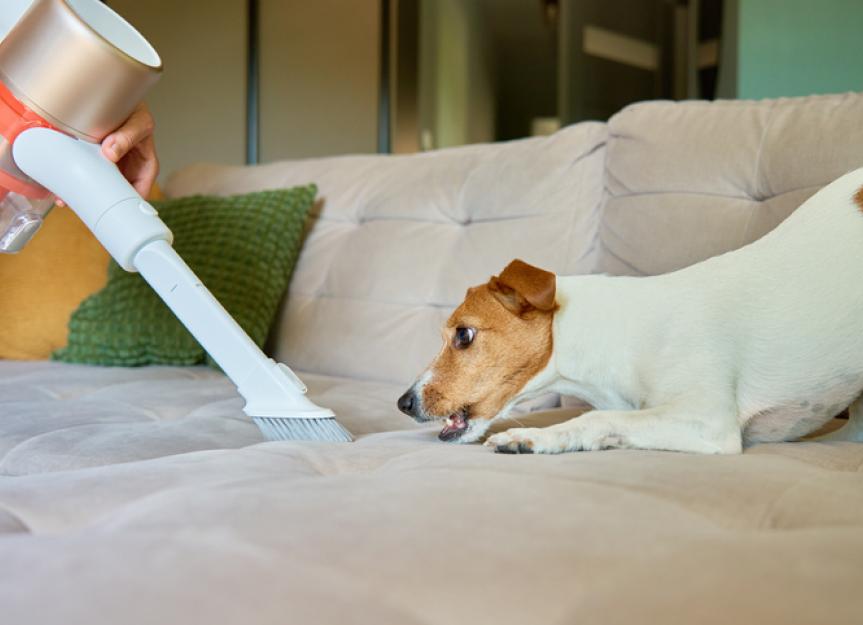
Vacuuming may not be one of your favorite tasks, but for dogs, it can be downright scary.
If your puppy tends to be anxious on cleaning days, here's what might be going on.
Key takeaways
- Dogs are often afraid of vacuum cleaners because the loud noise, vibration, and unpredictable movement can seem overwhelming.
- A lack of early positive exposure or a previous frightening encounter with a vacuum cleaner can cause lasting fear.
- Some dogs bark or lunge due to fear, protective instincts, prey drive, or overstimulation.
- Choosing a quieter vacuum cleaner can help reduce stress.
- Desensitization and counterconditioning can help dogs learn to stay calm around vacuums.
Why are dogs afraid of vacuum cleaners?
There are three main reasons why dogs are afraid of vacuum cleaners.
Sensory overload
Dogs have a better sense of hearing than humans. They are able to pick up sounds at much lower intensities and higher frequencies than humans. This means that even if you are bothered by the noise of your vacuum cleaner, your dog might find it terrifying.
Vacuum cleaners also create vibrations that dogs can feel through the floor. And even if you consider the vacuum cleaner a useful cleaning companion, your dog might find a bulky monster “invading” his home.
From a dog's perspective, vacuum cleaners are also unpredictable. They come and go depending on the day, turn on and off suddenly, and move erratically throughout your dog's territory.
A bad experience
Puppies have an important socialization window which is between 3 and 12 weeks of age. Dogs who were not introduced to vacuums in a positive way during this time often find them alarming later. And just one frightening encounter during this window often has long-term negative effects as well.
A frightening encounter with a vacuum cleaner as an adult dog can have a similar effect. If your dog has ever been surprised or injured by a vacuum cleaner, this memory may linger.
Temperament
Some dogs are simply more sensitive and prone to fear reactions than others.
For example, if your dog has a noise phobia and is afraid of thunderstorms, fireworks, or other loud noises, he may very well also be afraid of the vacuum cleaner.
Why do dogs bark at the vacuum cleaner?
Some dogs who are afraid of vacuum cleaners try to run away, but many bark or even lunge at the appliance.
Your dog might bark at the vacuum cleaner because of:
-
Herd instinct: Some dogs, especially herding breeds like Border Collies or Australian Shepherds, may attempt to move the vacuum to where they think it should be.
-
Overstimulation: Barking can be a way for excited dogs to release energy.
How to choose a less stressful vacuum cleaner for dogs
Here's how to choose a less stressful vacuum cleaner for your dog:
-
Check your current vacuum cleaner. Make sure it is in good working order. A clogged filter or worn motor, belt, or brush roll can make a vacuum cleaner noisier.
-
Opt for a robot vacuum cleaner. If your dog is truly terrified, a robot vacuum might be your best option (although it's not always as powerful as the others). Indeed, robot vacuum cleaners:
-
Are low to the ground and move more slowly and predictably
-
Allows you to schedule cleaning sessions while you and your dog are out of the house
-
Include many quieter models, like the Shark Matrix Auto-Empty Robot Vacuum, which operates quieter than many traditional vacuums.
-
-
Choose an upright vacuum or a quiet canister vacuum. Full-size vacuums are often noisier than stick or robot models, but some are designed to reduce noise without sacrificing suction. The Miele Classic C1 Turbo Team bagged canister vacuum cleaner, for example, is both quiet and effective at removing pet hair.
How to help a dog who is afraid of vacuum cleaners
You can teach your dog to stay calm around a vacuum cleaner using desensitization and counterconditioning.
These training techniques help your dog relax and associate emptiness with something positive:
1. Present the void as a neutral object
Start by leaving your vacuum cleaner in a room while it's turned off. Let your dog approach and sniff it on his own terms.
2. Add movement, praise and rewards
Once your dog is comfortable approaching the void, introduce slow, deliberate movements. To do this, move it back and forth while it's still off.
As long as your dog stays calm, give him plenty of praise and training treats, like American Journey Grain-Free Soft and Chewy Training Bits.
3. Present audio remotely
This is often the hardest part and it helps to get another person involved.
Have someone else operate the vacuum away from you and your dog, such as in a separate room behind a closed door.
The person who owns the vacuum cleaner should turn it on for about 10 seconds and then turn it off, repeating the pattern for a minute or two.
As long as your dog remains calm, give him treats while the vacuum is on, not if he gets upset or the vacuum is off.
4. Gradually decrease the distance
Over the course of several sessions, move the running vacuum closer to your dog while continuing to reward calm behavior when it is on.
Monitor your dog's body language carefully:
-
Relaxed posture, relaxed muscles and a willingness to take treats mean your workout is going well.
5. Work towards normal suction
Eventually, your dog should be able to stay calm around a running vacuum cleaner.
Other ways to help a dog who is afraid of vacuum cleaners
There are a few other things you can do to help your dog on vacuuming days.
Don't add to the stress
Anytime your dog reacts negatively to vacuum, it reinforces that behavior.
If your dog is still becoming less fearful and you need to do a quick cleanup on your own, make sure he is out of the house or in a quiet room away from noise.
Hide sound
Running a noise machine, like the Yogasleep Dohm Classic Sound Machine, turning on the TV, or playing calming music can help quiet the sound of the vacuum cleaner when your dog is in a separate room.
Finally, never tease your dog with the vacuum cleaner or punish him when he is afraid. These actions only reinforce the fear and erode the confidence you have worked so hard to build.
With a little love and positive reinforcement, most dogs can learn to tolerate emptiness.
Dog and Vacuum Cleaner FAQs
Why don't dogs like the sound of vacuum cleaners?
Dogs have more sensitive hearing than humans. While the sound of a vacuum can be irritating to humans, dogs feel it much more intensely.
Are dogs afraid of robot vacuum cleaners?
Sometimes. Some dogs may be afraid of robot vacuums, but many find them less frightening than traditional models because they operate quieter, have a lower profile, and move slowly and predictably.
Can dogs get used to vacuum cleaners?
Yes. Dogs can get used to vacuums through desensitization and counterconditioning, which teach them to relax and associate vacuuming with something positive, like treats.
You can practice this yourself or your veterinarian or a veterinary behaviorist can design an individualized program for your dog.
Should I comfort my dog while he vacuums?
Yes. Providing calm and treats while the vacuum is working can help create a positive association over time.