
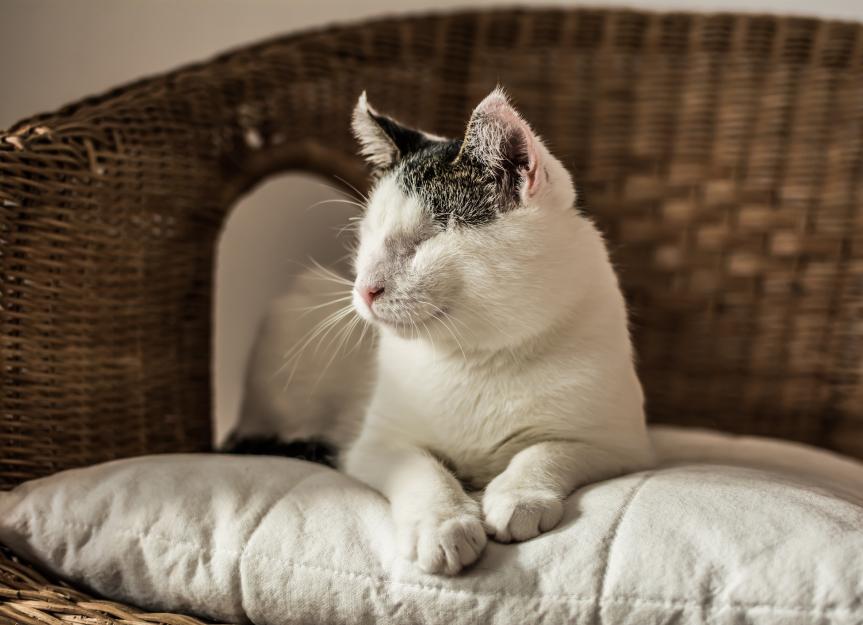
Blindness in cats can appear suddenly or develop slowly over time.
Although not all causes of blindness are treatable, the sooner you notice that your cat is losing vision, the better your chances of stopping the progression or reversing the disease.
Here, you'll learn about the symptoms and causes of blindness in cats, as well as how your veterinarian will manage your cat's vision loss.
Key takeaways
- Blindness in cats can develop suddenly or gradually and can be caused by eye disease, high blood pressure, trauma, infections or underlying conditions such as kidney disease.
- Sudden loss of vision is an emergency and early veterinary care can help stop progression or even restore vision in some cases.
- Although not all causes are reversible, many blind cats adapt well with a safe, predictable home environment and appropriate medical management.
What is blindness in cats?
Blindness in cats refers to loss of vision. This vision loss can happen slowly over time or happen quickly.
Blind cats most often have a problem with the eye itself, although it is also possible that certain nerve or brain problems cause blindness.
Although most causes of blindness in cats are not immediately life-threatening, sudden loss of vision should still be treated as an emergency.
In some cases, prompt treatment can preserve your cat's ability to see.
Symptoms of Blindness in Cats
Symptoms that could show that your cat has gone blind or is going blind include:
While blindness develops slowly over time, cats often adapt, so it may take some time for pet owners to notice that their pet has lost vision.
Symptoms are usually more obvious if the vision loss is sudden.
Causes of blindness in cats
Blindness in cats can occur with:
-
Retinal detachment: The retina is the layer at the back of the eye that detects light and transforms it into signals that the brain can interpret or “see.” Retinal detachment is common in cats with high blood pressure and/or kidney disease. The retina is essentially washed away from the back of the eye due to high blood pressure, so blindness is usually sudden.
-
Glaucoma: Glaucoma is an increase in pressure in the eye (intraocular pressure). Fluid builds up in the eye, putting pressure on the optic nerve that leads from the eye to the brain. The optic nerve can be damaged, leading to vision loss. Treatment can slow the disease, but glaucoma is generally not curable.
-
Cataracts: Cataracts are opacities or cloudy spots in the lens of the eye. These interfere with light reaching the retina. When a cataract covers the entire lens, blindness can occur. Untreated, cataracts can also lead to glaucoma or uveitis (discussed below), which are other potential causes of blindness in cats.
-
Uveitis: The uvea is the part of the eye that includes the iris (colored part of the eye) and several other components. When this area becomes inflamed (swollen), it is called uveitis. If left untreated, the disease can lead to blindness.
-
Eye infections: Eye infections can lead to large ulcers (sores on the eye) or uveitis, both of which can lead to blindness. Infections can be bacterial, viral or fungal.
-
Progressive retinal atrophy (PRA): PRA is a rare hereditary genetic disease that mainly affects Abyssinians and Persians. With this incurable disease, the retina slowly thins and loses its function. The disease is not painful, but it cannot be cured.
-
Eye or head trauma: Trauma to the head or eye can cause blindness from direct injury to the eye, pressure on nerves from swelling, or swelling of the brain.
-
Optic nerve disease: The optic nerve transmits signals from the eye to the brain. Any disease of this nerve, such as optic neuritis (inflamed nerve), can lead to blindness.
-
Brain tumors or diseases: The brain interprets the signals collected by the eye. Thus, a tumor or brain disease could affect vision. Brain swelling or brain tumors can also compress the optic nerve.
-
Eye tumors: Masses that develop in the eye can affect the way light is sent to the retina and cause other conditions contributing to blindness, such as glaucoma or uveitis.
-
Anesthetic complication: Blindness is a rare complication of anesthesia in cats, potentially caused by decreased blood flow to parts of the brain or eye. The condition is usually temporary.
-
Eating problems: Cats fed an inappropriate diet, such as a vegan diet, may develop blindness. Taurine is an amino acid commonly found in animal products. If taurine levels are too low in a cat's diet, blindness can result. Lack of vitamin A can also cause vision changes.
Diagnosis of blindness in cats
Your veterinarian will talk to you about what you see at home and perform a physical exam. Parts of the physical exam related to vision may include:
Your veterinarian may also recommend measuring your cat's blood pressure and performing blood tests to check for conditions that may contribute to hypertension, such as kidney disease.
In some cases, the veterinarian may refer you to an ophthalmologist (eye specialist) for further testing. An example of a specialized test is an electroretinogram (ERG), which checks whether there is an electrical response in the retina to the presence of light.
If brain disease is suspected, an MRI may be recommended.
Treatment of blindness in cats
Treatment depends on the underlying cause and the reversibility of the disease.
Treatments may include:
When the cat suffers from systemic problems such as kidney disease, these will also need to be managed.
If the disease is not reversible and the eye is painful, removal of the eye (enucleation) may be recommended.
Recovery and Management of Blindness in Cats
Some causes of blindness in cats, such as progressive retinal atrophy, cannot be cured. As the progression of PRA is slow, these cats generally adapt quite well to their blindness.
In cases of retinal detachment, partial or complete healing can occur within a few days to several months if the cat receives treatment promptly after onset.
During the recovery period or if your cat's condition is permanent, you can help your blind cat by not making major changes to the layout of your home.
These cats need a safe and predictable environment.
Consider blocking off stairs, using an option like this MidWest Pet Gate or this Unipaws Tall Narrow Gate, and covering sharp corners in your home.
Blind cats should never be allowed outside unsupervised.
You can avoid surprising your cat by talking to it when you approach.
Consider placing bells, such as Coastal Pet Dog Bells, or tags on other animals in the house so your blind cat can hear them when they move.
Prevention of blindness in cats
One of the key things you can do to prevent blindness in cats is to stay on top of your pet's annual wellness visits.
Detecting and managing conditions that cause high blood pressure can prevent retinal detachment.
You should also have any changes in the eye examined promptly rather than taking a wait-and-see approach. Untreated infections or ulcers can progress to uveitis, which can lead to blindness.
Cats with PRA should not be bred, as the disease is hereditary.
Blindness in Cats FAQ
What are the first signs of blindness in cats?
If the blindness is sudden, the cat will walk into objects and behave disoriented. With the slow onset of blindness, it may be more difficult to notice that your cat has gone blind. They may walk along walls for guidance or act confused if you rearrange your house, or you may notice that their pupils always seem dilated.
How to treat blindness in cats?
Not all cases are treatable. If blindness can be treated, treatment may involve topical medications, oral medications, or surgery.
Can cats live with blindness?
Most cats eventually adapt to blindness quite well. Yet some causes of blindness, such as brain tumors, may not have a good long-term outlook.
How to check a cat's eyesight?
Currently, veterinarians do not have a technique to systematically check the quality of your cat's vision. They can simply determine if your cat has vision and if there are any problems that could affect their vision. The veterinarian will examine your cat for a threat response to see if he has vision.