
Horses, like many other mammals, have two complete sets of teeth during their life: baby teeth and adult teeth.
When it's time to extract their baby (baby) teeth, the process is sometimes incomplete. This is called a retained dental cap in horses; the permanent tooth grows, but the milk tooth remains. It may be loose or at an abnormal angle, causing irritation to the mouth.
Horse owners who have young horses should be alert for retained dental caps and learn to recognize the signs in case their horse needs help.
Key takeaways
- Young horses aged 2 to 5 years are at risk of retained dental caps. This is the age when permanent teeth appear and baby teeth fall out.
- If the baby tooth is in a position where the adult tooth is not pushing it back, a retained dental cap will result.
- Retained dental caps that are causing a problem can be examined and possibly removed by your veterinarian.
What is a retained dental cap in horses?
A retained tooth cap occurs when a baby tooth fails to be completely pushed outward by an erupting adult tooth. The roots of the baby tooth may retain some soft tissue connections and therefore cannot detach from the gum tissue. This is called a “cap” because the baby tooth often rests on top of the adult tooth as it is pushed out.
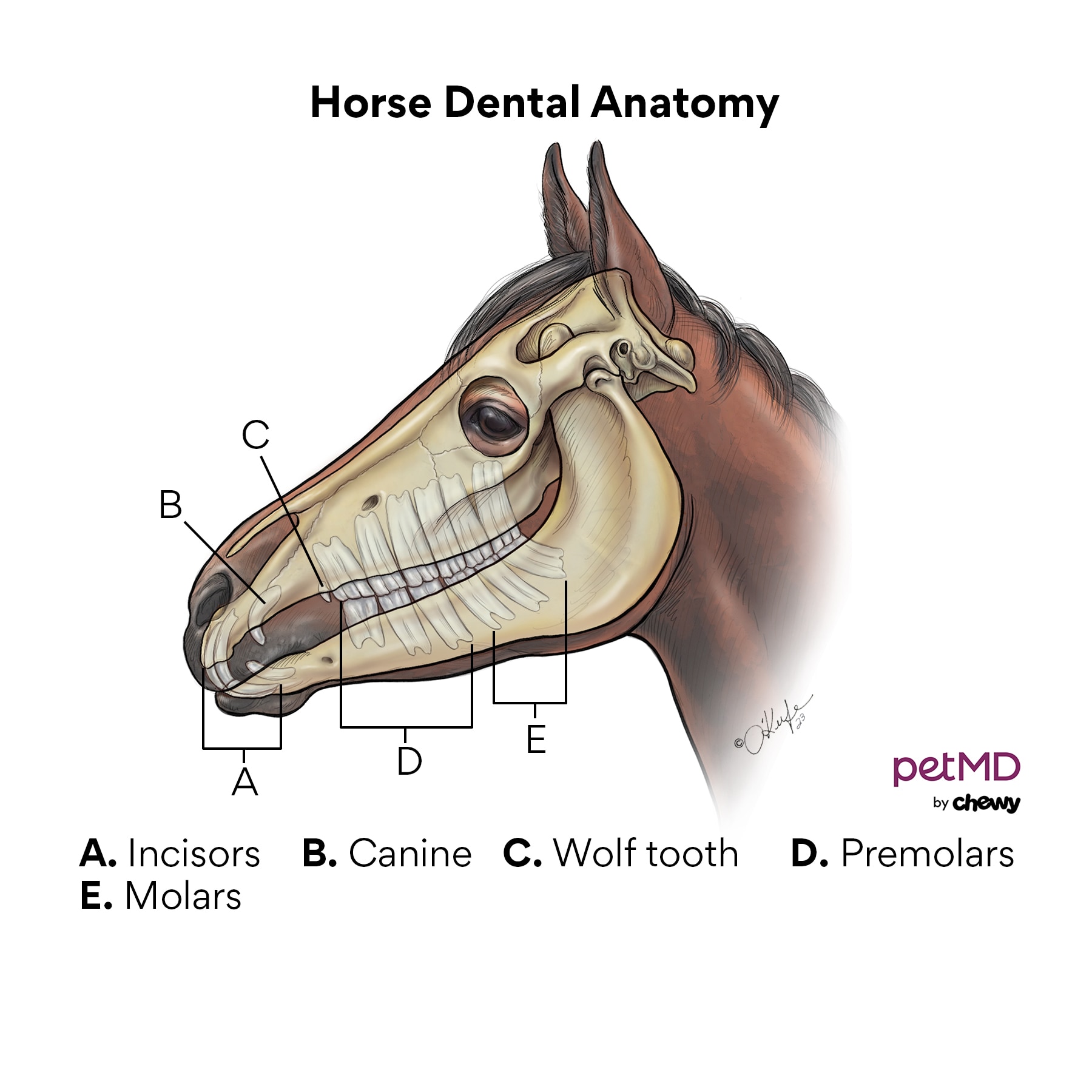
Dental caps are normal, but retained caps do not occur as often. Retained caps can be difficult to recognize if your horse has no symptoms. The caps may fall off before the owner realizes there is a problem, so not all retained caps end up being examined by a veterinarian.
Horses with retained dental caps often have a genetic predisposition to this condition. Thoroughbreds, Quarter Horses, Standardbreds, and Warmbloods are breeds commonly seen with retained dental caps, but they can appear in any breed of horse.
Symptoms of Retained Dental Cap in Horses
Horses may or may not be symptomatic with a dental cap retained. Symptoms can be very subtle and include:
What causes retained dental caps in horses?
The causes of retained caps are mainly genetic and can appear in certain lines of horses. The main causes include incomplete absorption of the root of baby teeth and problems with tooth and jaw alignment.
Treatment of Retained Dental Cap in Horses
Contact your veterinarian if your horse shows signs of oral discomfort, whether from eating or riding.
Your veterinarian can perform a complete dental exam under sedation, using a speculum to hold the horse's mouth open. This allows them to see all the way to the back molars. If there are tooth caps, they can be evaluated and the veterinarian will determine if they need to be removed.
While your horse is sedated while standing, your veterinarian will grasp the cap with a pair of long-handled extraction forceps. A slight movement may be necessary, but often the cap will come off with light pressure.
Once your horse is fully awake from sedation (usually after 1-2 hours), he can return to his normal routine. No restrictions on diet, exercise or participation are required.
Recovery and Management of Retained Dental Caps in Horses
You can give your horse a mash or senior horse feed if he is losing food or having trouble chewing.
Medications and anti-inflammatories are generally not necessary for retained dental caps. Once the troublesome cap is lost on its own or removed by your veterinarian, no further follow-up is necessary.
Prevention of dental cap retention in horses
Although it is impossible to completely avoid retained dental caps, steps can be taken to recognize the problem as early as possible:
FAQs on Retained Dental Caps in Horses
At what age do horses lose their caps?
Horses aged 2 to 5 years lose their caps. This is when adult teeth grow in. By the age of 6, a horse will have all of its adult teeth and retaining caps should no longer be a problem.
What are dental caps in horses?
Dental caps are the remains of deciduous (milk) teeth. Once the roots of a baby tooth die, the tooth cap is pushed outward over the erupting adult tooth. When examining a horse's mouth, it will actually look like a cap over the adult tooth.