
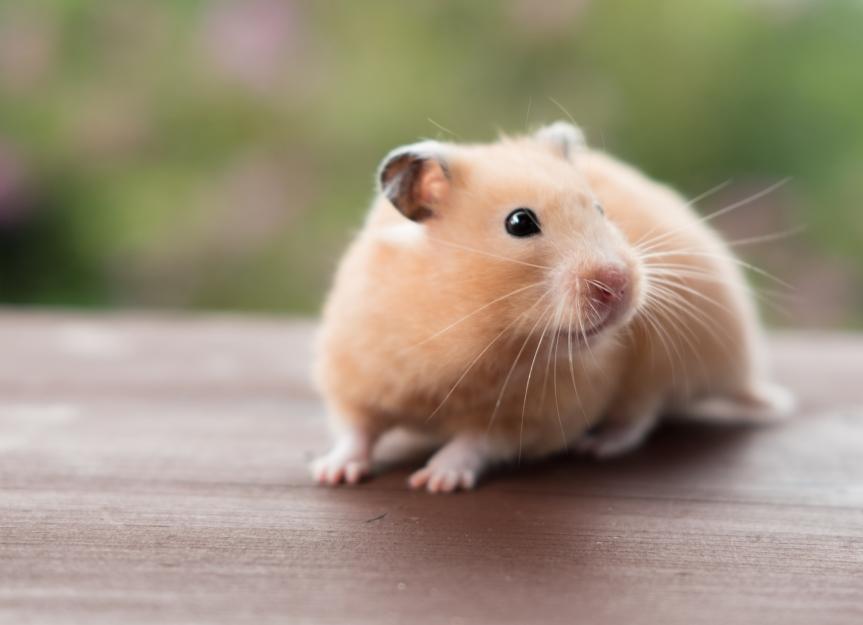
Pet parents often wonder: are hamsters blind?
These pocket animals sleep during the day and are more active at night. They also don't respond to visual cues like dogs or cats do.
Although hamsters don't see the same way humans do, they are not blind.
Understanding how hamsters use their senses can help you interpret normal behaviors and recognize when a true vision problem may be present.
Key takeaways
- Hamsters are not blind, but they have poor vision compared to humans, cats and dogs
- They rely more on smell, hearing and whiskers than on sight.
- Bumping into objects or easily startling is often normal behavior.
- Cloudy eyes, swelling, discharge or prolapse are signs that require prompt veterinary attention.
Are hamsters blind?
In most cases, unless affected by a medical problem, hamsters are not blind.
They simply cannot see as well as humans, cats or dogs. Because hamsters are nocturnal, vision is less important to them than hearing, smell and touch.
The idea that hamsters are blind often comes from their daytime sleeping habits and nocturnal activities. Hamsters may also bump into objects because they misjudge distances.
If you approach your hamster, it may startle when touched, even if it seems like it “should have seen you.”
These behaviors are often confused with blindness. They are normal for animals with limited visual acuity.
View of the hamster
In the wild, hamsters live in burrows and are most active at dawn, dusk and night. Like other burrowing animals, their vision is more adapted to low light conditions.
For this reason, they rely heavily on their other senses (hearing, whisker sensation, and smell) to navigate their enclosure and burrows. This sensory balance allows hamsters to move confidently through familiar spaces, even in dim lighting.
Overall, their eyesight is poor compared to diurnal animals (those active during the day). Hamsters are primarily nearsighted and cannot see objects far away or in fine detail. They can detect light, movement and large shapes.
Their eyes are positioned more to the sides of their heads, giving them a wider, more panoramic field of vision than humans, whose eyes are placed closer together at the front of the face. While this helps them monitor their surroundings, it limits depth perception and visual accuracy.
Hamsters have relatively large eyeballs for their body size, but the bony socket that houses the eye is shallow. This makes their eyes more prominent.
Their retinas contain more rods than cones. Rods and cones are photoreceptor cells that convert light into electrical signals, which are sent to the brain and interpreted as visual images. Rods detect light and movement, while cones are responsible for seeing colors and fine details.
Because hamsters have more rods, they are better at detecting subtle movements and changes in light, but they cannot see fine details or most colors.
Unlike cats and dogs, hamsters do not have a tapetum lucidum, a reflective layer behind the retina that improves night vision. This is the structure that makes a cat or dog's eyes shine when light shines on them.
Because hamsters lack this structure, they cannot amplify very low levels of light. Although they are nocturnal, they do not see well in complete darkness.
Blindness Symptoms in Hamsters
Although hamsters naturally have poor vision, true blindness or eye disease can occur. So it's important to know what signs to look for.
Vision loss can be gradual or sudden, depending on the underlying cause.
Signs that a hamster may be blind or suffering from an eye disease include one or more of the following:
When to Call Your Exotic Vet
If you notice any of these abnormalities, contact your exotics veterinarian immediately. Prolapsed eyes must be treated quickly to save the eye.
In cases of severe trauma, infection, tumors, or abscesses behind the eye, removal of the eye may be necessary if vision cannot be restored or pain cannot be managed. Early veterinary intervention helps prevent pain, infections and other complications.
If blindness is suspected, your veterinarian can determine the underlying cause and recommend treatment if appropriate. If the blindness is age-related or cannot be treated, they can also provide you with advice on ways to adapt your hamster's environment.
Fortunately, blind hamsters do very well. It is essential to maintain a consistent layout of cages, handle them gently, and minimize environmental changes.
Avoid frequently rearranging the enclosure, as predictable environments reduce stress and help blind hamsters navigate safely.
If the enclosure has ramps, tunnels, or raised structures, removing them can help prevent injury or entrapment. If you want to add huts, make sure they can be chewed by your hamster.
Are hamsters blind? FAQs
Can hamsters see you?
Hamsters can see you, but not clearly. Because they are nearsighted and cannot see fine details, they are unlikely to recognize faces. Instead, they rely more on smell, the sound of your voice, and routine to identify familiar people.