
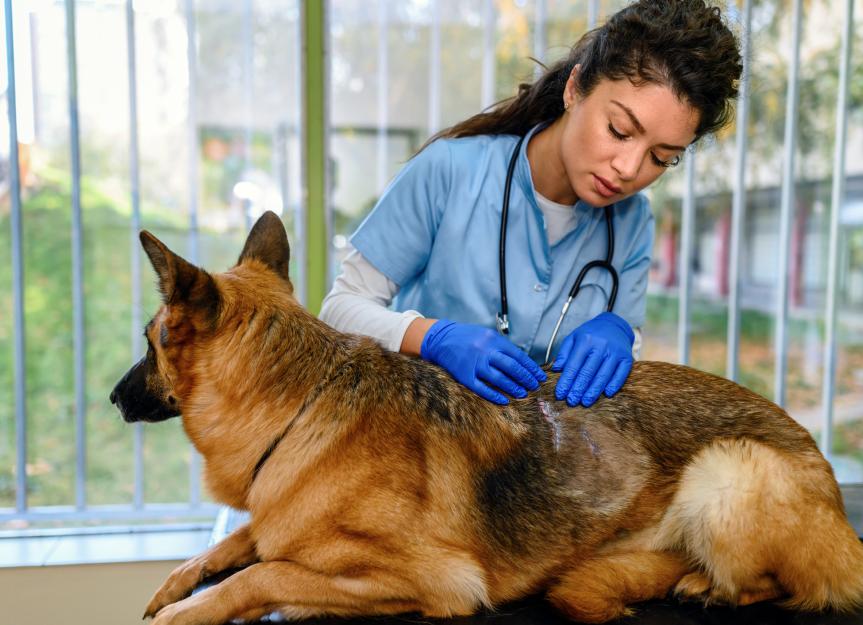
Dogs that are fly carriers have parasitic fly larvae that develop under their skin, usually causing a swollen bump with a small breathing hole. Although flies in dogs are rarely life-threatening, prompt veterinary treatment is important to eliminate the larvae, reduce pain, and prevent infection or tissue damage.
If your dog likes to sniff around rabbit or rodent burrows, especially in summer and early fall, he may be at higher risk of catching flies.
Fortunately, most cases can be treated with a simple veterinary procedure, and dogs usually recover well with proper wound care.
Key takeaways
- Flies in dogs are parasitic fly larvae that develop under the skin, often causing swelling with a small breathing hole or visible sore.
- Dogs commonly catch flies after exploring rodent or rabbit burrows, especially in summer and early fall.
- Veterinary ablation is recommended as soon as possible to prevent pain, infection, tissue damage, or complications.
Summary
Flies are the larvae of Mignonrebra fly, a common fly found in North America that resembles a bumblebee. These pests are also known as cuterebras or warblers. A dog with flies has a grub-like larva growing under its skin.
Sometimes pet owners will notice a small breathing hole above the swelling where the larva is developing. When the larva finishes growing, it leaves the dog after three to six weeks, often leaving an empty wound or abscess.
Although flies are not considered a medical emergency, they should be treated promptly (during the veterinarian's normal office hours). Make an appointment with your veterinarian as soon as possible.
Symptoms
The most common symptoms of flies in dogs include:
Causes
Flies found in dogs usually lay their eggs near rodent or rabbit burrows. Dogs usually become infected when they rummage through these burrows and accidentally encounter a larva.
The larvae enter the dog's body through open wounds or through the nose, eyes or mouth.
Dogs who like to hunt are at greater risk of catching flies.
Small breed dogs weighing less than 10 pounds (like Yorkshire Terriers, Rat Terriers, and Jack Russell Terriers) are more sensitive because they are so close to the ground when sniffing around rodent or rabbit burrows.
From summer to early fall, your puppy may have a higher chance of finding flies, as this is fly hatching season.
Diagnosis
Most flies in dogs are diagnosed during a thorough examination.
Your veterinarian will look for a firm swelling and/or pore where a chirp is present. In rare cases, advanced imaging may be recommended if a botfly enters the central nervous system, resulting in neurological signs.
Treatment
Flies in dogs are usually surgically removed.
Your veterinarian will likely put your dog to sleep or put him under general anesthesia to keep him comfortable and still during the procedure.
Often, dogs are treated with antihistamines to reduce their risk of an anaphylaxis-like reaction to the parasite when it is eliminated.
The area will be cleaned and sterilized, and the pores will be enlarged to allow the removal of Mignonrebra larva. If there is dead skin damaged by larval growth, it will be removed and the area rinsed thoroughly.
After the procedure, affected dogs are often prescribed antibiotics, such as Clavamox, and/or pain relievers such as carprofen.
Recovery and management
After removal of the botfly, the wound should be kept clean and allowed to heal from the inside out.
Antiseptic flushes may be helpful. Chlorhexidine solution can be diluted (1 part chlorhexidine rinse: 10 parts water) and used to clean fabrics daily.
Always talk to your veterinarian before applying topical products.
Healing usually takes 10 to 14 days, but sometimes longer, depending on the severity of the wound.
Keep your dog on a leash and away from rodent or rabbit burrows when he has an open wound to reduce his risk of reinfection.
Prevention
It is best to prevent flies by keeping your dog away from the burrows or dens of rodents and rabbits.
Conventional pest control products, like NexGard Plus or Simparica Trio, can help keep pests away and kill them when they are small.
FAQs About Flies in Dogs
How do I know if my dog has flies?
Dog flies often look like firm swellings with a central pore, most commonly on the dog's face or neck.
How do I get rid of flies on my dog?
Flies are treated by carefully and surgically removing them intact (whole).
Killing the larva while it is still in your dog can increase the risk of an anaphylactic reaction.
How long can a botfly live in a dog?
The larvae typically develop for two to three months before leaving the host (your dog).
What happens if you don't remove a botfly from a dog?
If you don't remove a fly, it can cause pain and tissue damage while in your dog's body.
Eventually all flies will leave the host, but the wound they leave behind may become infected and require veterinary care. In rare cases, flies can cause a fatal illness called systemic inflammatory response syndrome (SIRS).